Detours

detourWhen I was new to driving in the States, one of the signs that would make me end up with a panic attack was the ‘Detour’ sign. I grew up in a community that was largely pedestrian, and I developed my road sense mostly by walking. If I walk down a street – chances are pretty high that I will remember that street for some time. Many americans have the same kind of road sense with driving. I was not born here, I learnt to drive much later in life and did not have that. So, in the pre GPS days – whenever a sign appeared that said ‘Detour’ – I would have a panic attack. I did not know the alternate road and where it joined up with the one I was on. I did not know where it would take me and how I would find my way back to where I was supposed to go. But the detour signs did not stop appearing because I did not like them. I had to find a way to develop a better road sense – it would never be as evolved as the one I grew up with but I needed it for sure.

As far as career choices go – I had similar issue a couple of years ago. I had quit my stable DBA job which I had for 6 years and made a move to another position in a company that was being bought out. The writing was on the wall that many of us would be let go soon and I had to find something else quickly. In addition to that – I was in a serious car accident and suffering PTSD which was causing severe insomnia, amongst various other issues. I had no energy to get acclamatised to a completely new and stressful work environment. So I went with what my heart told me, picked up the phone and called a friend from the company I had left. He was not a SQL guy, he managed the windows team there – he had a spot open on his team, for someone who could do Systems Center operations manager, among other things. They had newly acquired SCOM and SCCM and were having a hard time finding experienced help. SCOM is a product closely married to SQL Server – I saw an opportunity to help, and I loved the people I was going to be working with. So I took the job, and worked it for a year and a half until I quit a week ago for another promising DBA position. There were many things I learnt during this career detour –
1 Most SQL folks I know suffer a sort of a paranoid attachment to their work – ‘I can only do SQL Server and nothing else’. Even the mention of Oracle or MySQL is intimidating and is met with ‘no no, not my area of interest and so on’. Some of the fear is valid – Oracle for example is not an easy product to learn and there is no point pretending you can just learn it as you go and get somewhere with it. But some of it is just resistance to change. There are many products married to SQL Server – like SCOM. Or SharePoint. There are many other database products that are relatively simple to learn – like MySQL. So it is important to look at our resistance to branching out into learning other stuff.

2 My good friend Brent Ozar often says that it takes upto 10,000 hours of dedicated learning to learn anything and get to expert level. I learnt from him not to have that expectation to begin with unless I had the luxury of that kind of time – it was important because setting goals too high and then failing was sort of a self sabotage too that was hindering my growth at many levels. I developed some skills with SCOM – by no means expert level but I learnt good scripting on vbscript and a basic level on Powershell. I also learnt a lot of things around monitoring – including the fact that generic monitoring tools can do certain things and we need deeper monitoring tools mostly for other things. Also to develop dashboards and metrics around mining a monitoring database – and how useful that can be to upper management if they are willing to exploit it.

3 I kept a constant eye though on my main area of expertise – SQL Server and database technologies. I kept up my learning with viewing courses on Pluralsight, PASS Summit recordings and attending sql Saturdays/user group meetings. I learnt after a certain period of time that becoming a SCOM expert was not something I really wanted to do and got back on track with SQL Server again.

By far the most valuable lesson I learnt though – was similar to the one I learnt on the road. Not to fear detours. They can and they will happen. To develop a ‘road sense’ of where I am, and where am going, and how my path will sync up to the one I was on. It has left me with renewed confidence in myself and my ability to handle life as it comes.


 

Finding most used alerts and monitors to override

I had a requirement from one of the teams that uses SCOM monitoring – the requirement was to change alerting level on scom alerts from critical to warning for all servers that were not on production for BizTalk management pack. Now there are several rules and monitors related to this management pack – or in general any one management pack – there is no quick and easy way to override all of them. To do so manually would be very cumbersome and time consuming. Instead – a better way to approach this would be to find rules and monitors that generate the most alerts and override them instead. This would create the override for most relevant rules and monitors – the others can be overridden as and when they happen. The query I used to find most used rules and monitors is as below. I wanted the BizTalk management pack – this can be substituted with any other as necessary.


Use OperationsManagerDW

SELECT

alt.AlertName,

COUNT(*) AS AlertRepeated

FROM Alert.vAlertResolutionState AS ars INNER JOIN

Alert.vAlertDetail AS adt ON ars.AlertGuid=adt.AlertGuid INNER JOIN

Alert.vAlert AS alt ON ars.AlertGuid=alt.AlertGuid INNER JOIN

vManagedEntity ON alt.ManagedEntityRowId=vManagedEntity.ManagedEntityRowId

WHERE

alt.AlertName like ‘%biztalk%’

GROUP BY alt.AlertName

ORDER BY count(*) desc

TSQL Tuesday 66 : Monitoring

This TSQL Tuesday post hosted by Cathrine Wilhelmson has to do with Monitoring.

During my many years as a DBA i have had a fair share of experience with monitoring tools – some of them as listed:

1 Spotlight for SQL Server – great tool for server level monitoring with very cool graphics. What i really liked about spotlight was that it was so very non-techie friendly – so whenever the director or VP chose to walk by and wants a peek into server health – all I needed to do was to pull up the screen and show him the dials whizzing around. On the flip side, spotlight did not help a whole lot with query tuning. It was also rather difficult to integrate with our ticketing system to generate tickets.

2 More recently, I have been working with Systems Center Operations Manager as our enterprise wide monitoring system. SCOM is a really complicated monitoring system to work with – but once you get familiar with it there is a lot it can do – in particular what I really liked was its ability to open tickets on its own within our ticketing system(with some customization of course), as well as close alerts on its own too when the alerting situation was resolved. SCOM calls for a dedicated admin  (which is part of my job), and a lot of tuning to get it down to where it only alerts on what you need without a whole lot of extra noise. SCOM is also NOT a tuning tool – it is only an alerting tool.

4 There are some situations that fall completely outside the realm of third party monitoring tools- for example, we need an alert whenever a user is added as a server role on some servers. We had to write a really simple script that would pull people who are on server roles, set it up as a job to email us every day in case something changed.

**Beginning of script – authored by Mala Mahadevan

SELECT role.name AS Name, member.name AS MemberName,
CASE WHEN (role.is_disabled) = 1 THEN ‘DISABLED’ WHEN (role.is_disabled) = 0 THEN ‘ENABLED’ END as     ‘Status’

INTO #temp_dbo
FROM sys.server_role_members

JOIN sys.server_principals AS role

ON sys.server_role_members.role_principal_id = role.principal_id

JOIN sys.server_principals AS member

ON sys.server_role_members.member_principal_id = member.principal_id AND

–filtering for logins that come from our domain
member.name LIKE ‘prod%’

–Format email

SET @tableHTML =    N'<H1>Server Role members on Server A</H1>’ +

N'<table border=”1″>’ +

N'<tr><th>Name</th><th>Role</th><th>Status</th>’

+

CAST ((

SELECT  td = CAST(([Name]) AS nvarchar(100)),”,

td = CAST(([Membername]) AS nvarchar(100)),”,

td = CAST(([Status]) AS nvarchar(100)),”

FROM #temp_DBO

ORDER BY name

FOR XML PATH(‘tr’), TYPE) AS NVARCHAR(MAX) ) +    N'</table>’
SET @Results = isnull(@tableHTML, ”)

–Email the team on findings
EXEC msdb.dbo.sp_send_dbmail

@recipients =

‘mydbateam@mydba.com’,

@subject =

‘Server Roles on Server A’,    @importance = ‘Normal’,    @body =

@Results,    @body_format = ‘HTML’


DROP TABLE #temp_DBO

What it took to stump the optimizer

Sometime ago I was working with a Microsoft support technician on a ticket related to some database issues on SCOM. The technician wanted to run a stored procedure to clear out some of the backlog we were seeing with a batch job.

When he ran the procedure (via Query Analyser) – we encountered an error as below. Basically an error that is wee bit rare, the optimizer telling us that it is stumped and the query is too big for it to process. The technician moved on to other ways of resolving the issue as fixing this problem involved touching some procedures that came with the product and was beyond the scope of our call. But after we were done, I was intrigued to find out what caused the optimizer to give up.scomoptimiser

I went to Line 177 of the specified stored procedure and found a statement that looked pretty small on the outside:

DELETE dbo.[CategoryOverride]

FROM dbo.[CategoryOverride] CO

JOIN #BaseManagedEntitiesToPurge BMETP

ON CO.[InstanceContext] = BMETP.[BaseManagedEntityId]

The table CategoryOverride had about 300 rows..and  on checking what went into the temp table – it wasn’t all that large either, only around 100 rows. Looking at the estimated plan from the optimizer gave me nothing – a perfectly ordinary plan with an equijoin on a clustered index. So what was causing the problem?

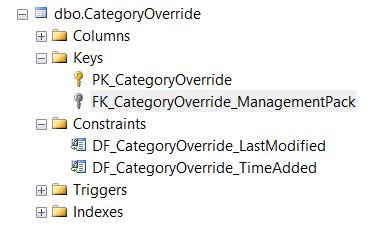
I looked to see if the table CategoryOverride had any triggers on it. None. Then I went on to looking at keys. The table had one foreign key defined on it.

scomo1

I decided to script this key and see what it showed me.

ALTER TABLE [dbo].[CategoryOverride] WITH CHECK ADD CONSTRAINT [FK_CategoryOverride_ManagementPack] FOREIGN KEY([ManagementPackId])

REFERENCES [dbo].[ManagementPack] ([ManagementPackId])

ON DELETE CASCADE

GO

There was my culprit – an ON DELETE CASCADE. So many other tables is this touching? A quick look at the dependancies on this table showed me no less than 14. For one record to be deleted – there were dependancies on 14 tables. I picked one record on the main table and counted how many dependant records were there to clean up. It was about 6000. So the delete statement was far from a benign straightforward delete – it had a huge amount of data to clean up and the optimizer could not generate a plan across 14 tables some of them having more cascade deletes on them.

Moral of the story – never assume the simplicity of a statement based on looking at it, or what the query optimizer tells you. The truth may be much deeper. If I had the choice of fixing it I would remove the cascade delete and go on to cleaning up data step-by-step in each of the dependant tables.

TSQL Tuesday #61 – Giving back

This TSQL Tuesday is hosted by my friend Wayne Sheffield. The topic is on ‘giving back’..what do you think you can ‘give back’ to the sql community in the upcoming year?

When I was new to this country – I had a friend who was a psychotherapist by profession. Towards the holidays – when everyone took time off, went shopping, decorated homes and so on – she would be working double , sometimes triple shifts. She worked for herself, so nobody really made her do this. But it was the time when business boomed for her. More people were depressed and low towards the holidays causing more therapists to be in business. Now, I come from a country with a lot of poor people. Seeing more people depressed instead of happy during a festive season was news to me – but that is topic for another post. The point as she explained to me was that the need to give without adequate self nourishment made a lot of people feel very depleted and as a result, depressed and low. In some ways , our small community is also reflective of the bigger outside culture – we expect people to give more and more – volunteers need to do more, the people on PASS board need to do this and that, MVPs and friends who are doing well need to recommend jobs…on and on. What are we doing to ensure appreciation and self nourishment within our community?

I don’t mean prepping people up or tweeting about how much we love each other and so on , although those things are important. I mean things like looking out for someone who is out of work. If you find any opportunities that he/she may be interested – let them know. Put in a word of recommendation, if you can do it. Share your own stories, not just of successes, but of failures. Like the time when a technical interview was really hard and you knew in 10 minutes that you were a poor fit. Or the time when you wondered how having 500+ linkedin contacts is not leading to any successful job leads. Or when everyone is talking of the sqlserver job market booming and there is nothing remarkable happening in your neck-of-the-woods. We all have times like that. Sometimes, sharing those stories is the best thing we can do to help someone who is depleted. As I write this, I know of 4 people who are looking for work. They are all smart, hardworking, caring individuals who have given to community and are in need of self nourishment. My goal is to be there for them in whatever way I can. And for people like them, in the year to come.

User Group Funding: Twitter Chat summary

I was part of a very interesting chat on twitter on how to find funding for user groups and SQL Saturdays. The conversation was initiated by Brent Ozar with an RT of Andy Warren’s blog post stating that running chapters is a lot of hard work. It was followed up with an active discussion on funding and how to find more funding to support chapters, particularly smaller ones. Those who participated include – Brent Ozar, Grant Fritchey, Kendal Van Dyke and Andy Warren. Matt Velic and me added our thoughts also. Following are some interesting observations.

On funding for small groups:

Me: ‘Funding for small groups has become inconsistent after UGSS and Idera pulled out of consistently sponsoring.’
Kendal: ‘Ideally that’s where SQLSaturday activities can help fund the group for the year.’
Matt: ‘SQL Sat would have to charge a fair amount to fund for a whole year’.
Brent: ‘Charge $25 for SQLSaturday,still the deal of the century’.
Andy:’Hard to justify cost/effort/reward for small groups if you’re a sponsor. Have to find ways to change that’.
Kendal: ‘Having a marketing plan, good look/feel, consistent messaging – all help bring in more sponsors.’
Grant:’ Fact is, small UGs suffer. I know. Trick is, minimize your needs, don’t emulate big groups.’

On topics and speakers:
The topic deviated to if or finding big-name speakers was important or as important as topics. I spoke to my experience that big names draw big crowds – at user groups or sql Saturdays. Others chimed in as below.

Brent:There’s less of a “celebrity” factor in the SQL community than folks think.For most attendees, local presenters *are* stars.
Andy: ‘Topic matters as much, or more.’
Grant : ‘ Another vote for more. Topic wins huge. I’m seeing that more & more.’
Grant: ”Fight like heck to get big name speakers, even if it’s just remote.’

On drawing bigger crowds of people :
We had some debates on quality versus quantity of people. Charging a fee might mean fewer people but draw those who are really interested.
Brent – ‘Vendors want quality too, not just quantity’.
Grant – ‘Speaking as a vendor, we want quality, but let’s face it, quantity has a quality of it’s own.’

Everyone agreed that Andy had done a great job with Orlando SQL Saturday and also with blogging consistently on these issues. We look forward to more posts and guidance from him (with other thoughts and ideas also). as we move forward into the next year.


TSQL Tuesday #60 – Something new learned..

This TSQL Tuesday is hosted by my good friend Chris Yates – the topic is on something new learned in the recent past. It is a simple topic but can sometimes be hard to articulate. I am a big believer in an open mind and learning anything new that comes my way – and have learned that the older you grow the harder this can be. The one practical lesson I claim to have learned, finally, in the recent past – is to sell myself and my work better. Or..to put it in other words, that publicity for what you learn and do is as important as the work itself.

I grew up in a culture that did not think too well of people – in particular women, being very extroverted. That combined with the fact that I was home-schooled for health reasons did not make me a huge extrovert by nature. My good friend Kevin Kline once did a survey of geeks and explained that most people who take to computers in a big way are, in some ways introverted. I don’t think being introverted has anything to do with self esteem, or even being shy or anti social. I just think these are preferences around how we are – that we prefer quality company over numbers, and are somewhat deliberate in our thoughts and actions. I do think though that it does impact how we sell ourselves – or publicise our work. For someone to know you you need to get out there and show them who you are – or it is more likely that those people who know far less than you do and drum up their work better will get the right chances to get ahead.

In my 13 years of attending the PASS Summit – I have always tried to spend time in classes, attending the occasional evening party. This time, I did something different. I spent most of my time networking – hanging out in community zone, asking people if they’d like to do lunches or dinners where we shared each other’s cares and concerns, and introducing myself to many SQL celebrities I had only known by name. I found the experience very rewarding – I got a lot of insight into options for career advancement, upcoming trends and changes in nature of work (more telecommute, more data analytics, more ‘unlimited’ vacation…) – not to mention the emotional support from a  huge number of #sqlhugs. I was selective, of course – in some ways, like I have always been. I usually hang with people whom I feel are genuine at some level, not just all about fluff, and are intuitively easy to relate to. That is something that I will want to keep.

My good friend Grant Fritchey once remarked  to someone who was a very strong techie and yet very humble and unassuming – ‘you need to be more assuming’ (he meant that you need to sell yourself more/better). That , in one sentence has been what I learnt recently – to be more ‘assuming’ while being true and genuine, at the same time.

TSQL Tuesday #59 – My hero(es) – The Quiet Achievers

I decided to resume my effort at consistent blogging again..after more than a year..with this week’s TSQL Tuesday Invite – this invite is by Tracy McGibben and is on ”Heroes”. There are many heroes in the SQL world who have inspired me and continue to. But there are two among them whom I wish to single out for this post.

1 Joseph Sack – I met Joe during a Sqlskills Immersion Event at Florida. I had known him to be the former director of MCM program before he joined SQLSkills, and I had a mental image of him to be atleast twice as older than he really was. Joe was much younger, very smart and thorough in what he knew, kind, funny and very easy to be around with. Soon after that event Paul Randal put out the yearly mentoring program that they do, and the candidates each of them had picked to mentor. I was long looking for a mentor – and was a bit saddened that I did not make it. I sent out a personal request to Joe – asking if he would mind mentoring me. Honestly did not expect to hear anything in the affirmative but he responded immediately – yes, he would be happy to. I spent a year on mentoring program with Joe – talking every month on things that mattered to me and asking for his advice, suggestions and like. After a few months we would up good friends who shared each other’s cares and worries rather than just a mentor and mentee. What impressed me about him initially are the same qualities that impress me still – humble,  down-to-earth, hard working and always willing to lend a helping hand. (Unfortunately Joe is no longer on social media or blogosphere for me to add any links). Proud to know you and be your friend, Joe.

2 Wayne Sheffield – I met Wayne as a speaker for one of my SQL Saturdays. That particular SQL  Saturday was not really a great event for me and my team. Two of my most senior volunteers had to depart to attend to some personal duties – I was very short on help and struggling to pull together with many things falling apart. One of the things that ‘fell apart’ were speaker shirts, which were misplaced. I was unable to find Wayne’s shirt – he had come with expectation that he would get one and needless to say, it was not the best experience for either of us(The shirt was found later). But the year after – I went on SQL Cruise Alaska, and joined Wayne and his family the day before for a tour of Seattle underground. During the cruise I got to know him much better and we are good friends. I have since followed his journey towards the MCM and various job changes too.He has  always been there to help me – with SQL advice, professional help, or just lend a listening shoulder. Like Joe – the qualities I admire with Wayne are his patience, humility, hard work, down-to-earthiness and willingness to help.

‘A person is known by the friends they keep’ is an old saying – so if people know me by my friends such as these, am sure I am known well 🙂 As a last word – would like to recommend everyone to find  people they vibe well with, not just people who are celebrities or big names. Find people who understand who you are, and are willing to support, encourage and motivate you. And do the same for them. Attend programs like SQL Skills or the SQL Cruise – they are not just for learning, I  have found some of my best friends this way.

Finding new goals…

The sudden and sad demise of the #sqlmcm program had me thinking on many levels..particularly on future goals and aspirations, and on how to market myself.

To give an introduction of some sort – in my younger years I was not particularly in favor of degrees or certifications. I was strongly of the belief that experience, interest to learn and creativity were the ‘real’ stuff that got you places. I dropped out of a high tech engineering program where I was 1 out of 300 people selected from among nearly 60,000 people who took it, and chose to pursue my life and career based on what I believed I had – interest in technology, creativity and hard work. Needless to say, it was not an easy journey. Particularly in a country like India where degrees and certifications were almost a cultural obsession. After a few years of working poorly paid jobs I went back to school for my masters. My masters degree and the process of doing it taught me many positive things. One, that having a hard goal – such as an exam or someone to rate me gave me better focus than learning on my own. Two, degrees helped you get through visas and other places where you do not have personal interaction with whoever is handling your stuff, and three, it helped you find community among others who had similar degrees. I never went crazy about degrees or certifications, but I did learn their place in the world, the hard way.

In the sql server world, there are many paths to progress. The most common one, by far, is by speaking/blogging/becoming a technical evangelist. There are many without MCM who have gone this way and been remarkably successful. But speaking and blogging unfortunately are not everybody’s goal nor does everyone have the time needed for it. To me – as someone who has a lot of food allergies, travelling intensively is really not a good goal to have. I have tried blogging but my time for it is rather limited and also not had success coming up with something creative to write about, I guess again that needs a lot of experimentation. That is part of the reason I picked the MCM as a possible goal. I was also interested in being differentiated from the average brain dump MCITP down the street by getting to be an MCM – and I did find this a worthy goal. Even saying you are pursuing an MCM at an interview got a lot of appreciative nods and interest. It also got employers to pay for good training programs such as those offered by #sqlskills, which they otherwise would not understand the value of.

Now with that certification gone we are back to the world where there is really not much by way of proof to tell an average employer how different you are from brain dump MCITPs. If you are like me into doing community work such as organizing sql Saturdays or running user groups you may want to use that to some extent but not everyone is highly impressed by community work to hire you, or even give you pointers to jobs (including people in the community itself). And to many of us it is not just about career growth or progress, it is also about acceptance among people you respect and acknowledge.

There is a scene in one of my favorite movies ‘A Beautiful Mind’ – where Professor John Nash – played by Russell Crowe, gets accepted and acknowledged for his intelligence after a nobel nomination. The other professors walk over slowly to him and hand him pens as a token of their respect and his acceptance into their club. I have a pen with the ‘Microsoft certified master’ printed on it – a little gift from the #sqlskills class I attended some years ago. It was my goal and the goal of many others I know to be accepted like John Nash was into the elite #mcm community. It is a sad day to have that taken away from us. It is my sincere hope and wish that all of us will find bigger and better goals to pursue.

SQL Saturday 2013 Louisville – A Recap

This year was SQL Saturday #5 in a row for us at Louisville. It was by far the best event we have had and we greatly enjoyed hosting it. Below are some things that worked and did not work this time:

What worked:

1 The location – ideally situated, no parking hassles, walking distance from the discounted hotel, all rooms on one floor, a very friendly and cooperative staff – in short everything we wanted in a location came through this time with this one. Our sincere thanks to Indiana Wesleyan University for hosting us (in particular to Leigh Ann Black) and our volunteer Dave Mattingly for finding them for us. We hope to have the next event(s) at the same location.

2 An enthusiastic crowd – although our turnout was not as high as usual (190 compared to 220+) we found most of the audience interested, appreciative and many stayed until the very end.

3 Our loyal speakers – over time we have grown a crowd of  speakers who attend our every event unfailingly – these include Kevin Edward Kline, Louis Davidson, Allen White, Tim Chapman, Dave Fackler and Craig Utley. Our thanks are due to these speakers (and  everyone else) whose knowledge and willingness to share it made the event a grand success. It may also be worthy of mention that Kevin unfailingly gets voted as the best speaker, and Tim has been the first guy  who made it upto the MCM from this town.

4 Sponsors – We put the sponsors in a separate room along with snacks and sodas. Almost all of them were very appreciative of the audience they got and promised to return again.  It may also be noteworthy that other than Quest/Dell Software and Confio and our local VSoft Consulting, all the other sponsors were first timers for us. Some like Embarcadero, Imperva  and BI Tracks did their first ever SQL Saturday sponsorship with us and wanted to return again. We consider this a huge victory not just for us but for the bigger SQL Saturday  community as well.

5 Post Event party – We did not have  post event parties at older events. The main reason for this is because we are a small volunteer crowd and all of us were very tired at the end of the day. Coordinating  another party was too much of an effort to pull off. This time VSoft Consulting stepped in as sponsors and coordinators, and we were able to host the first ever post event party. While it was not hugely attended, it was a good start and we will surely consider doing this again.

What did not work:

1 Pre Cons – We started with announcing 4 pre cons and ended up cancelling all of them. Three pre cons were cancelled at the behest of the speakers, who  were busy  with other work and did not find attendance big enough to book their time in advance. The last one had to be cancelled because the count of students was too small  for us to coordinate it. This made a few attendees unhappy and we were sorry that we had to do that. But some self examination helped us understand that pre cons were too much effort in addition to the sql Saturday – we are probably not going to have them again.

2 Speaker Shirts – We ended up with some shirts that were not of desired quality. The main reason  was that our order was placed in the last minute with a vendor who did a mix and match of suppliers. Our decision was to go with the Florida based SQL Saturday supplier that was used by many events , from next time.

3 Speaker Room – We had insufficient tables and chairs in the room that resulted in many speakers relocating to the lunch/registration room for chats and discussions . More attention to be paid to this later.

4 Speed Pass – We had a printer with us  for those attendees who did not show up with their speed pass printouts. Surprisingly this time it was quite a large crowd (roughly around 30-40 %). That resulted in the printer chugging along as fast as it could and two volunteers working the registration table non stop from morning until the last attendee strolled in after lunch. We also learnt by show of hands during the raffle that most attendees were first timers. This might be one of the reasons. From the next time we plan to work around this by having something different – like perhaps a $1 fee for those who forget their printouts.

5 Lower attendance than normal – We had about 20% less people than usual. We attributed the main reason for this to be our choice of date for the event – one week away from July 4th and a time when most people take time off for summer vacations. We will work better at finding a better date.

SQL Saturdays are team organized events, they are not one person effort no matter how motivated the organizer is. The success of this event is due to the hard work of our volunteers – Brian Carter, Dave Ingram, Dave Mattingly, Karen Schuler, Deana Ritter, Kenney Snell and newbies Scott Drake and James King. We hope to remain a team going forward and bring more events to the community. Our thanks again to speakers ,sponsors,volunteers and attendees who made it a grand success.