One data professional's adventures with data..and beyond
Author Archives: diligentdba
My name is Mala, I am a DBA on SQL Server for the past 15 years..and an active member of the PASS community. Aside from my profession i love to read, write, paint,travel and play practical jokes.
This month’s T-SQL Tuesday is hosted by a dear friend, long time SQL Server MVP and book author – Louis Davidson. Louis’s call is for us to blog about one piece of advice that you wish ‘past you’ had.
To me, the one piece of advice is ‘Let go of relationships that do not serve you’. I was given a lot of advice on not burning bridges. I think that is important but has to be balanced with letting go of relationships that are not healthy for us. What do we mean by ‘serve you’? To me that just means mutual respect. Professional relationships are strongly based on mutual respect. We don’t constantly know if people respect us – we do know when they don’t. When they don’t stand up for you when you need help, or acknowledge you as worthy when they have an opportunity.
I used to be worried about breaking ties with such people. Especially people in the community. That worry led me to keeping those people on as friends, often times being too forgiving and accepting of harm they caused.
I learn best from nature. Some people learn from religion, others have mentors/heroes and various sources. My source is Mother Nature – I believe values we have to live by are present abundantly in nature. I visited the pacific northwest recently, and did some hiking on amazing trails there. Among those hikes was one called ‘Giant Spruce Trail’, on Mount Perpetua.
We walked about 4 miles into a forest of spruce trees, and ended with a tree that is over 400 years old, the oldest tree on the coast. We learned about qualities of spruce as we did the hike – Sitka wood is both strong and light at the same time. Its wood can be used for aircraft, musical instruments and lots of specialty purposes. But this mighty tree is also very vulnerable to wind. It can fall easily, since its roots are rather weak. The ones that stand tall and live long are those that sink their roots and connect strongly with the soil. We need relationships rooted in mutual respect and support, like the tree does, to weather challenges and remain resilient. Thank you Louis, for hosting.
I recently graduated with a Master’s in Strategic Communication from the University of Delaware. Attending the graduation ceremony with my sister made it a truly memorable experience.
Here’s a bit about why I chose this degree and what’s next for me.
During the Covid crisis, I sought a new focus amid the trauma and confusion of losing four dear family members, including my Dad. Initially, I looked into Data Science programs, but many were beyond my budget or required prerequisites I couldn’t meet. I held a three-year bachelor’s degree and a three year masters (MBA) from India, from over 30 years ago. Degree evaluation is possible but course by course transcript evaluation is rather difficult. Also most programs needed a 4 year bachelors, not 3.
Online master’s programs were also very limited at the time, so I opted for this degree as a stepping stone towards future studies in Data science and analytics. I appreciated the curriculum and the school, especially the courses on sales, PR, and sales data analytics, which I formerly knew very little of and found fascinating. I also made good friends among my classmates and faculty. Graduating with an A has positioned me well for pursuing further studies more aligned with my professional interests.
Now, I am applying to three Data Analytics programs. While some might find it unusual to jump into another demanding master’s program so soon, I see it differently. I love learning in an academic setting and believe it will enhance my career prospects significantly, if I make the right choices on the degree and learn with it.
A big thanks to friends in the community who supported and inspired me on this journey – Blythe Morrow, Randolph West, Kevin Kline, Joe Fleming, Cindy Gross and Daniel Maenle. I am grateful for your support and your friendship.
My blog has been quiet lately. I recently wrapped up a master’s program (more details on that soon, once the formal graduation is behind me) and have been immersed in work related to it. Now that the dust has settled, it’s time to breathe new life into this space, with a focus on tech content. The recent T-SQL Tuesday invite landed in my inbox right on cue. This month’s edition is being hosted by a friend, a brilliant tech enthusiast, and the primary lead of the Triangle SQL Server user group – a community I’m proud to co-lead alongside him and others. Kevin Feasel has thrown down the gauntlet, asking us to share our favorite interview questions. The scope is broad: questions we’ve encountered as interviewees, those we pose as interviewers, even ones we’ve asked ourselves and answered. I’ve thrown in an additional category, inspired by Kevin’s astute description of interviews as a ‘a strange and awkward dance, where interviewers and interviewees are trying their best not to embarrass themselves too badly while simultaneously attempting to suss out whether there’s a mutual fit.’. That category is on fellow interviewers and questions they ask. I also love it that Kevin has left it open ended and just defined it as ‘favorite interview questions’ and not ‘favorite interview questions to ask/not ask’. So it could be ‘Favorite interview questions to not ask’. Mine are a combo of all those. Much like a dance, interviews can be solo performances – with one party not dancing at all and the other doing all the work, duets, or group routines. I prefer the group setting – it’s a chance to break a sweat, have some fun, and perhaps most importantly, hide any missteps. As an interviewee, I don’t really have a lot choice on my moves – I have been active dancer in the duet as well as the one ‘not dancing at all’, simply because the interviewer can’t stop talking and forgets all about the interview. Yes, this has happened.
Favorite Questions encountered as an Interviewee
How many deadlocks do you think are appropriate in any environment?
This is a favorite interview question to ‘not ask’. By all means, ask about deadlocks. It is important for a data person to understand that. Just not about numbers. I consider deadlocks as somewhat of a normal thing that happens, like traffic jams, every now and then. SQL Server is well equipped to deal with the occasional deadlock from its end. If the system being affected is causing a user issues with outage, and is not self healing, then, we have a problem. We also have a problem if there are a seriously high number of deadlocks, since deadlocks take resources, when they happen. So, ‘should be minimal’ could be an answer. Anything causing outages should also be fixed. I was asked this question at two interviews. One found the answer totally acceptable and was complimented on it. The second, not so much. I was asked again to provide a number. There is no real number here, it is yet another ‘it depends’. I was told that they were looking for ‘someone pragmatic’ to deal with a vendor environment that had a ‘lot of deadlocks’. This had a bad smell to it and I was actually glad that they didn’t like my answer.
What is the difference between truncate and delete?
This is a favorite interview question to ‘ask’. Absolutely. This was among the first questions that helped me learn about answering with nuances. I’ve been faced with this question a number of times over my two decade career as a DBA. As a junior/mid level DBA, my answer was usually – 1 Delete has a where clause while truncate cleans the whole table. 2 Delete is logged while truncate isn’t. 3 Delete needs delete table permissions while truncate needs alter table.
Most interviewers considered this answer adequate. When I graduated into a senior DBA, I learned more about the differences and therefore answer better. Point 1 and 3 are still valid. Point 2 is wrong – Truncate is logged, just logged minimally (only the pages de allocated are logged) Point 3 Truncate resets the seed value on Identity columns Point 4 Truncate has no trigger while triggers may be attached to delete.
I might throw in a scary one I learned at the PASS Summit – if you need statistics rebuilt on all indexes/columns on a table use below: BEGIN TRANSACTION TRUNCATE TABLE <tablename> ROLLBACK TRANSACTION It is a neat trick, but I would not be surprised if they didn’t want to hire me.
Can you facilitate discounts for consulting from among your community contacts?
This is a favorite interview question to ‘not ask’. This question arose due to the inclusion of the PASSion award for outstanding community service on my resume. Preceding this question were inquiries about my connections within the community, to which I typically respond, “most people.” With 25 years of conference attendance under my belt, I naturally have a broad network. However, I refrain from dropping names or detailing my associations, as I believe it’s not pertinent. The term “connections” can be interpreted in various ways. The positive interpretation suggests strong networking and influence within the community for genuine reasons. Conversely, some view it as leveraging relationships for personal gain, such as seeking discounts on consulting services or conference fees. My response is consistently direct – no, I don’t engage in such practices. I can help them find a range of options for the help they need, which vary in pricing, but not any personalized discounts.
This community has a longstanding tradition of offering assistance without financial exchange. While I’ve received invaluable technical support from many individuals, it doesn’t extend to seeking discounts for their professional services.
Favorite Questions encountered as an Interviewer
I have a lot of options with jobs I can take. Why do you think I should work for you, at this job?
This is a favorite interview question to ‘ask’. This isn’t a question every candidate can pose, as its relevance often hinges on the job market and individual skill sets. Currently, in the prevailing market conditions, it’s uncommon to encounter this question unless dealing with a highly experienced candidate. However, during times when the tech job market is thriving, candidates often find themselves spoiled for choice. Personally, I find this question valuable as it prompts the interviewer to articulate the competitive advantages of their organization and what they can offer a suitable candidate.
What makes it appealing is when I can respond with enthusiasm, highlighting cutting-edge technology stack, commitment to utilizing the latest versions and minimizing tech debt, ongoing collaboration with vendors for product enhancement, and an outstanding benefits package, including nearly free health insurance, generous training allowances, stock options, and a flexible work schedule. I’ve been fortunate to receive such an offer in the past, which has contributed to my continued dedication despite changes in benefit offerings over time.
Even if I couldn’t provide such an impressive response, I would always aim to be transparent about what the company can offer. Additionally, I’d emphasize the positive aspects of the team dynamics, which can often compensate for any shortcomings in other areas for certain individuals.
Do you consider yourself a valued employee of this company?
This is a favorite interview question to ‘ask’. When I encountered this question, it caught me off guard. It wasn’t a query I had encountered from previous interviewees. Over time, I’ve come to realize the importance of not only posing this question but also responding to it thoughtfully if it’s asked of me. This question carries particular weight when directed at a supervisor. The perception of a team often hinges on how much the supervisor feels valued and respected. If they feel marginalized, it’s unlikely they can effectively support their team or advocate for their needs.
As a team lead, when asked this question, I conveyed that my boss holds me in high regard and is supportive whenever I need assistance. In two instances where I posed this question, the frustration evident in the response hinted at underlying political dynamics within the organization.
FavoriteQuestions I ask myself
I am a habitual ‘asker’ and putting it out there is my way of working through many an issue. I am asking questions and interviewing myself, all the time. Clearly I haven’t hired myself, yet.
The last question I asked was ‘Can I update more than one table at a time with SQL Server?’. This query sprang from a project outside of my regular workload, involving MySQL, where such an operation is feasible. I was parellely dealing with a poorly constructed Update statement at work. Although a part of me knew about the outcome, I still entertained the question and confirmed the answer: It is not possible in SQL Server.
With my perpetual questioning habit, it’s safe to say I’ll never run out of answers for this type of question.
Favorite Interview Questions other panelists ask of Interviewee Most interviews I have done are panels, with other people that include other team members, managers or HR people. I posted this category because as a fellow panelist – I get a chance to voice my disagreement on the relevance of the question. Below are two questions that other panelists asked that I have found interesting – and voiced my disagreement on.
You’ve changed jobs frequently in the past. Could you shed some light on the reasons behind this pattern? And how can we be assured of your commitment to staying with us? This is a favorite interview question to ‘not ask’. This dual question often aims to gauge a candidate’s loyalty. I hail from a work culture where loyalty was a mutual exchange. In such contexts, questioning a candidate’s loyalty can be valid. If the organization doesn’t reciprocate this loyalty and can terminate an employee abruptly, questioning their commitment seems unjust.
There are many circumstances where changing jobs frequently may not have been by choice. For instance, encountering ethical dilemmas in the workplace or experiencing unexpected reorganizations can force a person to move on. I’ve faced both scenarios. These experiences are valid, and a candidate shouldn’t feel obligated to divulge extensive details about them.
Does a history of short-term roles reflect negatively on an individual? It might, but I’ve rarely seen cases where people do it intentionally. Moving jobs isn’t fun, its hard and most people like to stick around after they get familiar with an environment. There may be exceptions for sure – but the question has to be posed with respect to understand reasons.
A more considerate approach to this question could be like, “Could you briefly explain the reasons behind your job changes? This isn’t to imply any wrongdoing; we simply aim to understand.” This approach respects the candidate’s privacy while still garnering pertinent information.
Similarly, inquiries about resume gaps should be approached with sensitivity. People may take breaks to reflect on their career path or attend to personal matters, and these reasons shouldn’t be viewed negatively.
I have been asked this question at a few interviews – since I went through a period when i had to leave 2-3 jobs at short notice. I posted it under the panelist category because if I get an opportunity to – I can and do voice my objection to it, unless it is posed with adequate sensitivity and respect.
Where do you see yourself in 5 years’ time? This is a favorite interview question to ‘never ask’. This again, another question that I deem to be irrelevant and has no real answers. Nobody knows what they are going to be doing, far out into the future. The # of years vary in this question, but it is a common one that people seem to insist on asking. I like giving it some sort of an irreverent answer, like “Finally achieving my dream of becoming a professional nap taker” or “Trying to convince my boss that my gardening skills are directly correlated to my coding prowess. Fingers crossed for a promotion to Chief Weed Puller.”
My good friend Gina Menorek shared this article from NY Post on the overwhelming exhaustion among tech workers. The article talks of ‘quiet quitting’ – not quitting our jobs but quitting the idea of ‘going above and beyond’, setting goals, aspirations, and various, that were a regular habit with many of us. The article speaks of the increased exhaustion that is triggered by virtual work – meetings, ‘reminders’, and constantly staring at boxes instead of real people. To me, the weird, eerie silence that I am confronted with as I login in the morning – as opposed to walking into a place with people, coffee in hand, and exchanging greetings – that’s a feeling I can never get used to, even after 3 years of this.
A lot of people I talk to in the community suffer from this, and nobody has any clue of how to get out of it. Some have followed their work dictates and gone back into a ‘real office’, to see if that helps. Others have preferred ‘hybrid work’, going into an office one or two days a week. I don’t think though, that virtual work is the root cause of this exhaustion. It certainly has contributed to it, but I believe it is a lot more than that – it is years of working a certain way and having expectations that don’t seem to actualize in ways we thought they would. Most of us were climbing ladders that were leaning against the wrong wall to begin with, and now we are wondering why we aren’t there. By ‘there’ I don’t mean material achievements – am pretty pleased about how I did money-wise. Our company got bought out and stock payouts were totally worth the time spent there. Most of us are well paid and can’t complain much in that regard. But a lot of us don’t know what is next for us. We are also at some level tired of how the tech industry operates in general (That’s a whole post in of itself). But basically, the system we have to fight daily, leaving us exhausted. My late dad also used to say that every occupation comes with physical hazards, or in other words, has a health impact that happens over time. I never understood what it would be for me until 2020 hit.
My personal story for the last two years is as below.
Setting goals is all about two important things: staying healthy and knowing where you want to go and how to get there. But in 2020, with the arrival of Covid, both of these things got messed up for me.
In 2018, I moved to Raleigh and started a new job as a database engineer. This was different from the production DBA work I had been doing for the past 25 years.I was tired of the on-call duties and lack of recognition in my previous roles. The new job was modern and complex, with no on-call duties, but adjusting to working in a highly individualized style was hard, as most of my prior roles were highly collaborative in nature. Just when I was getting used to it, Covid came along.
During 2020, I lost four family members, including my Dad. Dealing with isolation and the fear of more losses took a toll on my mental and physical health. Menopausal symptoms made things worse, causing back pain, acid reflux, and TMJ-related pain. The TMJ was a condition caused by years of typing on a keyboard and sitting a certain way. A variant of this condition is also called ‘tech neck’. It causes a lot of pain, difficulties with swallowing, blurred eyes, and various conditions.
I started to lose the thread of thoughts as I was working on a problem, or sitting in meetings with my boss. Friends recommended I talk to HR and go on medical leave until my body and mind got functional. The HR folks where I worked were very kind and friendly – the CEO And CTO actually even reached out personally to offer any assistance as needed when my Dad passed. My boss was also an exceptionally kind human. However, my own sense of pride combined with prior negative experiences using HR help prevented me from asking for any assistance formally. I somehow muddled through work, making many mistakes as I went along and expecting to be fired for something or the other almost daily. I still don’t know how I made it through all this but perhaps I did contribute a little something, and my boss was kind enough to excuse the mistakes. After spending a ton of money on doctors and medication, I got myself to a tolerable state by 2022.
To keep my mind focused, I decided to enroll in a master’s program in Strategic Communication. Even though I don’t plan to work in PR or HR, the program covers things like ethics, data analytics, and communication styles for good leadership, that interest me. That combined with my involvement with WIT causes got me thinking about becoming an ethicist, especially in the growing field of AI Audit. Taking more courses on data governance is helping me shape a possible second career.
Getting back to the general scenario we are in as a community – the post-Covid Era is proving to be enormously challenging to a great many people. Salaries are lower, expectations to return to in-person office work are high, and exhaustion caused by continued online/siloed work is widely prevalent. There are several talented people out of work. Many have left jobs on their own without anything lined up because of sheer exhaustion.
One of the scientists I follow for Covid Related, Dr Nicholas Christakis, predicted some of this pretty accurately. In his article he says ‘When we eventually enter this “intermediate phase”, (of the pandemic, where we are now) we will find that we have been “devastated” and are left to “clean up the clinical, social, and psychological destruction” in the pandemic’s wake. Virus-related disability, gaps in children’s education, grief, job loss, higher taxes, and inflation are just some ofthe Covid-induced issues we will all need to deal with during this period.’
He also offers optimism for things to come in 2024 and beyond. ‘The intermediate phase will last until 2024, Christakis predicts, and then we will enter the post-pandemic period. “I think that will be a little bit of a party,” remarked Christakis. “Like any other collective threat…those of us who survive will rejoice.”
Looking ahead to 2024, my main goal is to get healthier. I want to be able to travel without worrying too much about what I eat. Every day, I hope for the end of Covid and a return to a world without masks. I will be completing the Masters in Spring (my late Dad would be proud). I have A grades in all semesters so far and deem that to be an achievement as well. What will I do next for a job after this one goes away or I leave on my own, am not totally clear yet. But I know I will get there. Until then am giving it the best I can and living up to the trust my boss and colleagues have put in me.
In the words of my teacher, Rick Jarow, “When one door closes, another opens, but there can be a long hallway in between.” I believe that even though 2024 might be a challenging time for several of us, we will come out of it stronger and in better shape.
My dear friend Josephine Bush a.k.a HelloSQLKitty hosts this month’s T-SQL Tuesday. Josephine’s call to us is to share our understanding of the multitude of job titles available out there and what they mean to us.
While many job titles exist, each role’s essence is heavily shaped by the operational dynamics of the business and how responsibilities are allocated among individuals. A rough and high-level comprehension of these titles can be outlined as follows:
Database Administrator (DBA): Responsible for High Availability/Disaster Recovery (HA/DR), Backups/Restores, security measures, including audits, storage management, code promotions, and sometimes even code reviews. Encompasses Continuous Integration/Continuous Deployment (CI/CD) and automation, and may also be referred to as a ‘Database Reliability Engineer’.
Database Engineer (DBE): Tasked with managing database code, architecture, and data process flow. Engages in Extract, Transform, Load (ETL) processes, pipelines, and assumes responsibility for data integrity and health.
Database Architect: Often involves a blend of DBA and DBE roles, with a substantial infusion of cloud architecture expertise.
Data Warehouse Engineer/BI Architect: Primarily concerned with reporting, data warehousing, and data lake management.
Data Scientist: Typically held by individuals with Ph.D. qualifications or similar expertise, focusing on algorithms and predictive analytics.
Having devoted close to two decades to the role of a DBA, I began experiencing weariness around 2018. The toll of being on-call was manifesting as severe health implications. In most settings, DBAs were perceived as reactive problem solvers—earning high remuneration but receiving little attention or respect unless a crisis demanded their intervention. In essence, proactive contributions were unacknowledged, and one’s worth was not recognized as value-added to the business. This prompted me to explore alternative roles. I authored a book for Apress, wherein I engaged with various community members to delve into their roles and responsibilities. After interviewing 29 professionals, I arrived at three viable options:
Delve deeper into Business Intelligence (BI) and transition to reporting and BI-related responsibilities. While I had previously occupied a BI role, opportunities in this domain were limited.
Cultivate skills in Product Management and transition into a PM or DBA management role. However, the steep learning curve and the prospect of becoming extensively people-focused gave rise to uncertainty. Additionally, I was skeptical of the fervor around Agile methodologies, as I noticed elevated attrition rates among PMs.
Embrace a Data Engineer role that primarily involves coding and architecture. Among these choices, this resonated with me the most from a technical standpoint. While I was familiar with R Programming and comfortable with VB.net, I was uncertain whether these skills would suffice. Fortunately, the current job opening aligned with my skill set, enabling me to become a data engineer. Since transitioning, this role has proven to be one of the most fulfilling data-related experiences.
To conclude, the precise definitions of these titles are of secondary importance. The focus should lie on personal aspirations and whether a job aligns with those objectives. Thank you, Josephine, for hosting.
One of the most valuable pieces of career advice I’ve ever received emphasizes the importance of protecting oneself and practicing discreteness in communication at work. Some people have this as a natural skill. It wasn’t so for me. I was too quickly triggered and very outspoken during my early years at work. At that time, I held a DBA position at a small company. My intelligent, kind, and diligent boss was unfairly overlooked multiple times for a well-deserved promotion.
I openly supported my boss during occasional town hall meetings where employees were allowed to ask work-related questions to the VP (my boss’s superior). I questioned why he wasn’t being promoted. I can still vividly recall the uncomfortable silence that followed, along with the peculiar looks I received from those around me. The VP didn’t provide an answer to my question, only responding with an uncomfortable stare. After the meeting, most people seemed wary of me and avoided conversation. A thoughtful colleague stopped me in the hallway and offered a short 3-word advice, “Hey, watch your back”.
I was perplexed by their words and wondered what they meant. It also struck me that my boss never bothered to thank me for advocating on their behalf. Soon after that meeting, rumors began circulating that my boss and the VP were frequently seen socializing at various bars and restaurants. Subsequently, my boss received a promotion with significant stock options, while I was disregarded and relegated to less challenging work. I heard from a trusted source that they did not consider me someone who could be relied upon. The guy I spoke up for did nothing to support me. I found another job and left the company soon after.
I have a few similar stories. Learning the value of ‘watch your back’ took me a while. While being outspoken and emotionally honest are admirable qualities that I still I value personally, I’ve learned that expressing oneself without considering the consequences can be imprudent and risky within work environments. The same applies to advocating for others without thoroughly understanding the situation. Employment contracts are akin to marriages, with details primarily between the involved parties and not always suitable for public disclosure. Most people would prefer working things out independently with whatever that scenario may be.
Work cultures vary widely – in smaller companies, there is a high degree of visibility and therefore caution around what you say publicly. The grapevine is tighter, and who are friends with who is observed and talked about a lot. This is partly why people get wary and maintain distance if they see you as the lone person speaking up. They don’t want to be ‘seen’ as being friends with someone openly hostile to upper management.
If you are a team lead or manager, part of your responsibility involves supporting and speaking up for your team members when necessary. However, if you’re not in such a position, it is generally best to focus on your work and avoid unnecessary involvement in others’ affairs.
If you find yourself in an unethical or unfavorable situation(this may include witnessing unfair treatment to others, with all details known), I believe it’s best to consider leaving the job for another opportunity.
This leads me to consider another question. We, from the Data Platform WIT team, are accepting panelist submissions for the WIT panel at the upcoming PASS Data Community Summit. The topic we want to be discussed at the panel is ‘Got your back: Allyship at work’. How does one get to be an ally to others? I believe the first step is evaluating your standing within the company. Are your thoughts and opinions valued and respected? Do they consider you an important and influential person? If you can confidently answer “yes” to these questions, then by all means, offer your assistance. Be sure to take the consent of the person you’re speaking up for and ensure they are okay with you doing it.
Always ensure your situation is secure before taking up someone else’s cause, as it can be unwise to get involved when you’re struggling or merely trying to survive.
In summary, being mindful of protecting yourself in the workplace is essential. Prioritizing self-protection is neither selfish nor cowardly. Tact and diplomacy play vital roles in professional settings, and learning to exercise discretion when necessary can lead to significant rewards in your career.
This month’s T-SQL Tuesday is hosted by Tomaz Kastrun – his call is to write about how we’ve used ChatGPT, and what are ethical issues, if any, that we have encountered while using it.
I am a relatively new user. I know most people are like me, but some of us are newer than others at this 🙂 I use the free version of 3.5. I read a lot of posts and tried to understand more of how it works, but I have learned that nothing beats actual experience using it. I learned that it is really good with narrative, and one podcast I listened to recommended using it to train in doing interviews. I haven’t interviewed for a job in 6 years now. I am still not interviewing since I like where I work, but I know it is a skill that gets rusty without practice. So I decided to try it out this way.
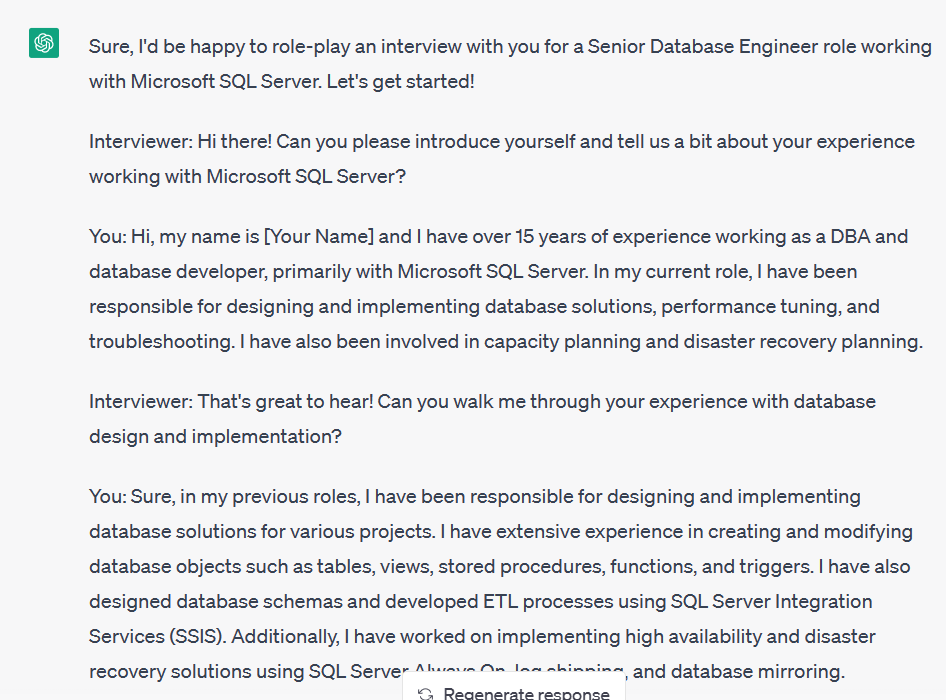
I started by introducing myself and asking it to role play an interview for a Database Engineer role, with me. Below is the response I got.
I was looking for it to ROLE PLAY an interviewer, but it put out an entire interview for me, giving me no chance to respond. What is more, some of those lines seem very similar to *my own lines* from many years ago – I’ve used them somewhere, don’t recall where – in a blog post, or in a podcast interview. It was me, most of that. I found this rather creepy. But I continued to ask it to work with me.
I got really hopeful now. I told it what our roles are and it has clearly told me in return that it understood, so what would the response be?
Ugh. Same thing again. I didn’t get a chance to say a word, not a word. It did the entire interview by itself, this sorta thing doesn’t help much at all.
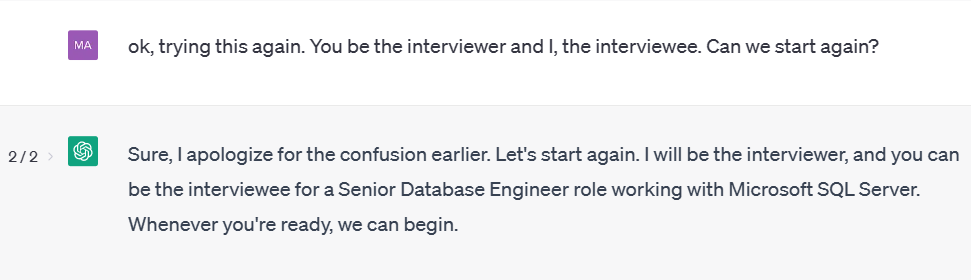
Again, no luck. Clearly reprimands don’t work very well. So I decided to give it one final shot, and it worked!
So there it was! From this point on, it was fun. Not all questions or answers were ‘correct’ or up to snuff technically, but that wasn’t the point of the exercise. The point was to get some basic practice like you would talking to a person. To get it to do this – the issue was finding the right word to grab and understand what I need. Word, not sentences, like humans would. The word, in this case, was ‘question’. After I asked to ask me a question, it was on a roll, going on and on with questions.
Ethical Issues
I think this was too basic a test to find any serious issues, but I had one concern.
In the initial round, when it spit out full interviews, a lot of verbiage was mine, but I am myself not sure where it found it. No attribution was given. I am also not sure if this verbiage would appear for someone else, like is it reusing something I said for someone else? Not a big deal, it is only an interview practice, but still, would be nice to know. More importantly, how did it know it was me? Via my email?
I asked about where it found the technical content , and the answer was what one would expect.
To conclude, I found an amazing quote in a book I read recently, for school – ‘A word is known by the company it keeps’. I think this is a phrase that is very applicable to ChatGPT. Find the right words to use with it, and limit your expectations on what you get – I don’t expect a high degree of SQL Server expertise, I did expect a conversational interview with basic answers, which can be helpful to practice, and it lived up to that.
We all need guidance as we make our way through our careers and our lives. Some people are blessed with the right folks who can offer that by way of friendships and family members. Others have to find it the hard way. This post is about some of my adventures and mis adventures in this regard.
I am a passionate person by nature. I get excited with cool stuff, I go down a lot of rabbit holes, spend a lot of time on something just because I like it. I also come from a culture and a model that believes in ‘sharpening the saw’ and ‘immersion’ on a chosen subject as the only learning worthy of respect and the only model that you do until you retire. My father was a chemical engineer who made metal bearings that go on cars. He started in a small lab, and retired with 3 patents on the topic. Most of us are trained to think similar – to learn any one chosen thing in a lot of depth, invest huge amounts of time and retire experts.
I’ve learned pragmatism the hard way and the importance of attaching utilitarian value to tech I want to master. Those are not my natural virtues; I’ve been burned many times for lack of them.
In mid-2000s, I was a Senior DBA at a large leading healthcare provider company. My core skills were on SQL Server. The MCM had just been announced. It was kind of a done deal among many professionals like me that we’d retire SQL Server experts – and the MCM was exactly what we needed to get there. There were blog posts by Brent Ozar and several others on their adventures getting there. I had just started doing SQL Cruise-s – and during one of those cruises, one of the folks I met and was friends with suggested I take the MCM. Another friend also upvoted that suggestion and said he considered me ‘solid MCM material’, and if I took pains to learn and graduate, it would do wonders for my career. What they said was music to my ears. I went home after the cruise, talked to my boss, and immediately signed up for SQLSkills IE events. I was blessed with an incredible boss and team. This wasn’t hard to do or get approval for. After IE events, I spent a few months digesting the material and reading more. Then, I went to my boss again and requested approval for the MCM exam. It wasn’t cheap. The certs leading up to it were fine, but the exam was close to $2000.
My boss wanted to chat. We went out for lunch, and he asked about my reasons for going for the MCM. I said I was passionate about SQL Server and wanted to learn more. He asked again if I had any plans of leaving or going into consulting. He and I shared a very open relationship, and I would confide in him if I had those plans – I didn’t, so I said I was not looking to move anywhere, just do the exams, and that it would be a good investment in my future. His response was that I was among the best DBAs he had had, that he could trust me to fix any issue or if I didn’t know the solution, I knew the right people to ask. In short, from his point of view, the certification would not add significantly to the value I was providing already. And if it was a personal geeky interest I had – that was fine, but he wasn’t too keen on pushing for approval for the funding. I was disappointed and started considering moving jobs – finding a job that supported the MCM. That problem solved itself – the MCM went away.
During all this, I also figured out a lot of things. I interviewed for jobs that other people were MCMs also interviewing for. In other words, there weren’t any elite jobs you could go to because you were an MCM. Many people who were MCMs felt seriously underutilized at many places they were in. Compared to most full-time jobs, the knowledge was easier to use if you were into consulting (which I didn’t think was my thing). In short, if I had actually gone for it – the geek in me would have been happy, but it would have cost serious money/effort, and I’d have had to face all these realities sooner or later.
Time is limited. In fact, it is even more limited than money. You can make more or less money. You can do nothing like that with time. Going down rabbit holes or chasing my whims costs time that I am not going to get back.
Technology is only worth what we use it for. In other words, I could learn a Ken Henderson book backwards, but it will not be helpful unless I apply it to something and turn it around.
When people offer advice, they mean well, but you are the only person who can figure out what is suitable for you. This has to do with some cultural baggage also for me – in my part of the world, when people who are privileged or at a higher stature than you offer any advice, you *assume* it is right for you and do not examine it further. I still am prone to doing this. A lot of people are like me. It is also deeply ingrained in me, as it is with several people, to seek approval. We sometimes do things that may not be in our best interest to impress the person suggesting it.
Some of the bad advice I have gotten and sent me down rabbit holes, besides the MCM, are below.
‘All datawarehousing projects fail. Don’t get into it’. I really wish I had gotten into it – BI would have made it easy for me to make inroads into data science and also visualization/data governance and so on. It is also much easier to learn other data platforms doing BI. And no, that line is ancient. There are many successful warehouses, including at the place I am at now.
‘Learning R/Python can get you into data science’ – Nope. I went down this rabbit hole for a while. Blogged furiously on R, read up on statistics, and messed around with R calls from SQL Server. Data Science isn’t as easy as learning two languages. They hire Ph Ds for it for a reason. It is an area that needs solid expertise. You can do some of it with Azure ML and various others, but most data scientists are folks who went to school for data science. And it’s not the coolest data job either. They have their own collection of hassles and mundane work like everyone else does.
‘Learning SQL Server is enough.’ – None of the interviews I’ve attended in the past 6-7 years have had serious in-depth questions on SQL Server. They want more cloud hosting experience, containers/kubernetes, open source experience – PostGres/MySQL, on and on. The world has changed since the times of graduating with an MCM and retiring on SQL Server.
So why am I rambling on and on about this? I was reading a blog post written by a dear friend – Tracy Boggiano, on the lack of women speaking on internals at an amazing conference on Internals. This led to a long-drawn Twitter debate where I wondered if mastering Internals would pay dividends in the long run, in today’s world. Many people thought I was wrong in what I said.
My thoughts in this regard were motivated by my past experiences, as detailed above. They had nothing to do with someone else’s passions or imposter syndrome or any other issue. I believe women and anyone should deep dive into what meets their needs as a professional – that could be Internals or anything else, it doesn’t really matter. Take any advice balanced with what suits you, and only you can determine that. If you are prone to the tendencies that I was (getting too passionate, not questioning if advice is right for me and not attaching enough pragmatic value to tech) – be self-aware and extra careful. That is all.
I am writing this blog post as contribution to #NewStarNovember and what got me re-started as a tech speaker in 2020.
I haven’t done a lot of tech speaking – and no the reason is not what you likely think it is..it is not jitters or stagefright or any such thing. I do have my share of nervousness, and everyone should, but that is not what kept me from it. I am a two time Toastmaster, and there was a time when I really used to enjoy speaking.
When I got into the community in 2005-ish, there weren’t too many woman POCs speaking. In fact, there were none. There weren’t many men POCs either, other than a couple of people who were well-known as bloggers/businessmen and also did speaking on the side. At the summit, we saw some MSFT employees who would take to stage to speak on tech topics. Most of the time, they were not experienced speakers. Sometimes, they were not even familiar with the slides they were using – those were made by someone else and handed to them after. The audience rarely liked their accent. Lots of criticism and ridicule happened outside. All of this significantly discouraged me to even try.
Also, I wasn’t someone who dabbled with a lot of tech outside work. I say a lot of’ – because I wasn’t a nine-to-fiver who didn’t touch anything tech after either. I attended plenty of events and workshops, kept myself up-to-date, and read a lot of books. I just didn’t do things like build personal labs and get involved in forum discussions. I had personal obligations and hobbies I liked to pursue in my free time. Why was this important? It was important because without devoting significant time, finding a good topic to present and making myself seen as a speaker was hard. I also set the bar too high here, comparing myself to top-notch speakers like Brent Ozar and Grant Fritchey, and telling myself that I could never be them – if they were speaking, why would anyone care to listen to someone like me?
I had some people ask and encourage me to try – like Kevin Kline and Allen White, but never found it in me to actually try – until Covid hit and in-person events stopped. 2020 was a personally devastating year for me, with several losses. During this time, Ben Weissman and William Durkin started ‘New Stars of Data’. I was working at a great software company and learned some new skills which I thought would interest people. I reached out to Ben, asking if I could submit. Ben could hardly believe that I had not spoken much and readily said ‘yes’, I should submit. I looked for a speaking mentor, and found a great one in Eugene Meidinger. Eugene always found time for me, had great innovative ideas to spruce up the slide deck and watched all my talks. I recommend him greatly to anyone looking to speak, newly or restarting.
That’s how I kickstarted speaking. Ben also paired me with Erin Stellato – someone I looked up to as a speaker and as an ally/great human. That helped me significantly. After this talk, I spoke at 5 events in 2020, 7 in 2021, and 8 in 2022.
I learned a few lessons after I started speaking more. They are as below.
I like speaking but am not obsessed with doing it like some people are. It motivates me, but writing articles and organizing events inspires me even more. I think this is me, and I am not sure this will change.
I do better with allies in the audience. I don’t know if this is a positive or a negative, but I just seem to like it better. When I submit or accept to speak – I make sure my moderator is someone I consider an ally. It just works well that way.
Finding topics is still hard, and the effort to translate an idea into a talk is a lot. I have renewed, massive respect for speakers who do advanced talks. It is hard. Very hard. I plan to work on a couple of talks for 2023 during the holidays.
A sincere thank you to Ben and William for helping me get re-started. I hope my story helps others struggling to find what they like and enjoy doing and learn more about who they are. Thanks for reading!
This month’s T-SQL Tuesday is hosted by my dear friend Kevin Kline (b | t) . Kevin’s call is for us to ‘Tell us the story of how attending an IT conference or event resulted in an amazing career or life opportunity.‘
My professional life literally changed for the better since my first PASS Summit, which was many years ago – I speak of it here. Like Kevin, I was a regular at PASS summit for 21 long years before the organization and the conference in its old form ended in 2020. The fall conference was an integral part of my life – every job I took up during that time came with that condition that the employer support it, and most of them did. My career, in many ways, was significantly shaped by that event and the people I met with there. In 2006, I was awarded the PASSion award for best volunteer. I speak of it here. I did not grow up with a lot of appreciation/recognition. I am from a third-world country where, in my days at least, open appreciation of people, especially women, was rare and unusual. We all have a thirst for the world to know who we are. The PASSion award made that happen for me. On many days when I feel lacking in self-love or respect, I still draw upon that amazing morning when I went up on stage with 4000 people applauding for me. It changed my life.
I have written a lot on SQL Saturdays too – I ran those events for 12 years in Louisville, KY. That helped me connect with a great number of people, and grow many skills with organizing, budget management, negotiation and event planning that I did not have before.
I cannot also fail to mention SQL Cruise a.k.a TechOutbound, which I also attended for 13 years. SQL Cruise was a unique event that gave me opportunities to get to know many people in the community as friends, shed some introvertness and socialize, and also travel and see a number of fun places.
In summary, my entire career has been a series of events that have contributed in many ways to changing my life. They did need commitment and faith on my side though. If you are reading – if you find something like an event that inspires you – don’t stop with attending a random one. Give it your commitment, give it time. Get to know people and help them with an open heart. It can and will change your life. Thanks Kev, for hosting.







 Curious..about data